
Personal Trainer in Sarajevo - How to Choose Right
How to choose a personal trainer in Sarajevo: credentials, experience, approach and chemistry, red flags, and what the first session with me looks like.
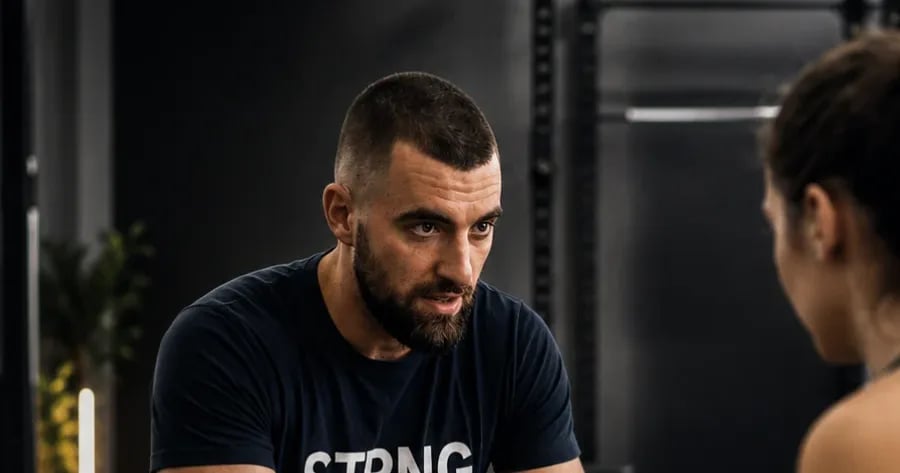
Search for a personal trainer in Sarajevo today and you will find one on every corner - in gyms, on social media, through friends' recommendations. So how do you choose the right one? As a coach who has delivered more than 200 sessions with clients at every level, from complete beginners to professional athletes, I will give you concrete selection criteria, the red flags to watch for, and a detailed walkthrough of what the first session with me looks like - so you know exactly what to expect before you invest your money and time.
How to Choose a Personal Trainer in Sarajevo - The Short Answer
You recognize a good personal trainer in Sarajevo by four things: competence (certifications plus real knowledge), experience with people like you (your goal, your age, your injury history), approach (do they assess you before they program for you) and chemistry (do you actually feel comfortable working with this person). None of these four factors is enough on its own. A trainer with five certificates who does not listen to you will not help you, and neither will a likeable trainer who hands everyone the same printed program.
The simplest test: book an intro conversation or a trial session. If the trainer spends the first hour talking about themselves instead of asking about you, that is your answer. If they ask about your goals, injuries, schedule and habits before they ever mention a plan - you are on the right track.
Certifications and Experience - What to Actually Check
Certifications are the start, not a guarantee
A certificate shows the trainer completed formal education - and that is the minimum you should never go below. But paper does not train people. Ask where they studied, what they learned most recently and how they keep up with the field. A trainer who stopped learning five years ago is coaching with five-year-old information. In my case, beyond my core education, I specialized in EMS training and in posture and technique correction, because those are the areas where clients most often struggle.
Experience with people like you
This is the criterion most people skip. A trainer can be excellent with competitive athletes and lost with a beginner who has back pain - and the other way around. Ask directly: "Have you worked with someone who has my goal and my starting point?" I spent years doing athletic conditioning with professional athletes, and that work set a standard of precision I now bring to everyday clients: every exercise has a reason, every set has a purpose, and everything gets measured. But working with athletes also taught me something more important - the program always adapts to the person, never the other way around.
Approach and Chemistry - The Underrated Factors
You will spend two to three hours a week with your trainer, for months. If that hour feels unpleasant, you will stop showing up - and the best plan in the world becomes worthless. That is why chemistry is not a luxury; it is a practical success factor.
Before becoming a trainer, I spent years working in premium hospitality, where the relationship with a guest is built down to the smallest detail. That experience is as valuable to me today as my coaching knowledge: a client has to feel that the session is their time, that someone is genuinely listening, and that every detail - from the greeting to the last set - happens with care. I believe that is one of the reasons over 95% of my clients stay satisfied with our work together and keep coming back.
How do you spot a good approach in practice? The trainer assesses you before training you, explains why you are doing what you are doing, adjusts the session when you arrive sleep-deprived or stressed, and keeps records of your progress. Everything else is improvisation.
Red Flags When Choosing a Trainer
Pay special attention to these signs - I have seen every one of them in the real world:
- The same plan for everyone. If you get a ready-made program before anyone asked about your injuries and goals, walk away.
- Promises like "lose 10 kg in a month". A serious trainer promises a process, not magic.
- No movement assessment. A trainer who loads a barbell on your back on day one without watching how you move is gambling with your joints.
- Phone in hand during your session. You are paying for focus, not for presence.
- Aggressive supplement selling. Supplements can make sense, but if selling powder matters more than your technique, the motive is clear.
- Pain gets ignored. "Push through it" is not a professional answer to joint pain.
- No progress tracking. Without written numbers, nobody - including the trainer - knows whether the plan is working.
What the First Session With Me Looks Like
To remove the unknowns - here is exactly how a first meeting goes when you reach out.
1. Conversation about goals and history (15-20 minutes)
We sit down and talk. I want to know what you want to achieve, but also why - because "lose weight" and "have energy for my kids" call for different approaches. We go through injury history, health status, how you sleep, how much you sit, what you have trained before and what you enjoyed about it. None of this is a formality: every answer changes the plan.
2. Movement and posture assessment (20-25 minutes)
This is where my work differs the most. I look at how you stand and how your shoulders, spine and hips behave. Then we go through the basic patterns: a bodyweight squat, a hip hinge, a lunge, pushing and pulling, trunk stability. I am looking for asymmetries, stiffness and compensations - posture and technique correction has been my specialty for years, and most future problems show up right here. If you work at a computer eight hours a day, I will almost certainly find shortened chest muscles and sleepy upper-back muscles.
3. Short trial workout and the plan (15-20 minutes)
Based on the assessment we do a light introductory workout - usually 4-5 exercises, 2 sets of 8-12 reps each, just enough for me to see how you respond to load and for you to see how I coach. At the end you get my proposal: how many times per week, what we do together, what you do on your own and how we will measure progress. No pressure and no signing anything on the spot.
In-Person or Online Coaching - Which Is Better for You
I work in both formats, so I can be honest about the pros and cons. In-person training is irreplaceable while you are learning technique: a correction within a second of your knee caving in is worth more than ten video messages. In person we can also do EMS training, which is excellent when your time is short, and the technology requires me to be there. Online coaching is the right choice if your technique is solid, your schedule is unpredictable or you are not in Sarajevo: you get a plan, video analysis of your recorded sets and regular adjustments. Many of my clients combine the two: they start in person until technique is set, then move online with occasional check-in sessions.
How Often Should You Train With a Trainer
It depends on experience and budget, but as a framework:
- Beginner: 2-3 sessions per week for the first 6-8 weeks. This is where technique and the habit are built - the most expensive mistake is saving money on exactly this period.
- Intermediate: 1-2 sessions per week plus 1-2 independent workouts following my plan.
- Advanced: 1 session per week or even every two weeks, as a technique and progression check, with the rest done independently.
My goal is never for a client to depend on me forever - it is for you to know more and more over time, and to need me in smarter ways: for assessments, corrections and the next level of the plan.
Questions to Ask a Trainer Before You Start
Bring this list to the first conversation - the answers will tell you everything:
- What certifications do you hold and when was your last continuing education?
- Have you worked with someone with my goal and my limitations?
- What does your assessment look like before the program starts?
- How do you track progress and how will I know the plan is working?
- What happens if something bothers me or hurts during an exercise?
- How do cancellations and make-up sessions work?
- Do you offer a trial session before I commit to a package?
A trainer who answers these questions clearly and without dodging is probably the right choice. A trainer who is annoyed by these questions - is not.
Choosing a personal trainer in Sarajevo ultimately comes down to trust backed by evidence: verify the knowledge, ask for an assessment, use the question list and listen to how you feel after the first meeting. A good trainer will welcome that process, because they are also choosing clients they can genuinely get results with.
Training delivers the best results when the plan is built for you - your goal, your schedule and your current level. I bring years of work with professional athletes and hundreds of EMS and personal training sessions, and today I coach clients in person in Sarajevo and online. If you want a plan tailored to you, see how I work and get in touch.
FAQ
- How do I know if a personal trainer in Sarajevo is good?
- Check their certifications and when they last continued their education, ask about experience with people at your level and goal, and request a trial session. A good trainer assesses you before programming for you and answers every question clearly.
- What happens in the first session with a personal trainer?
- With me, the first session has three parts: a conversation about goals, health and habits, then a movement and posture assessment, then a short trial workout. At the end you get a concrete plan proposal with no obligation.
- How often should I train with a personal trainer?
- I recommend beginners do 2-3 sessions per week for the first 6-8 weeks while technique is being built. Later, 1-2 sessions per week combined with independent workouts is enough, and advanced clients come as rarely as every two weeks for check-ins.
- Is in-person training better than online coaching?
- In person is better while you are learning technique and for EMS training, because corrections happen in real time. Online works great once your technique is solid or your schedule is unpredictable. Many clients start in person and then switch to a combination.